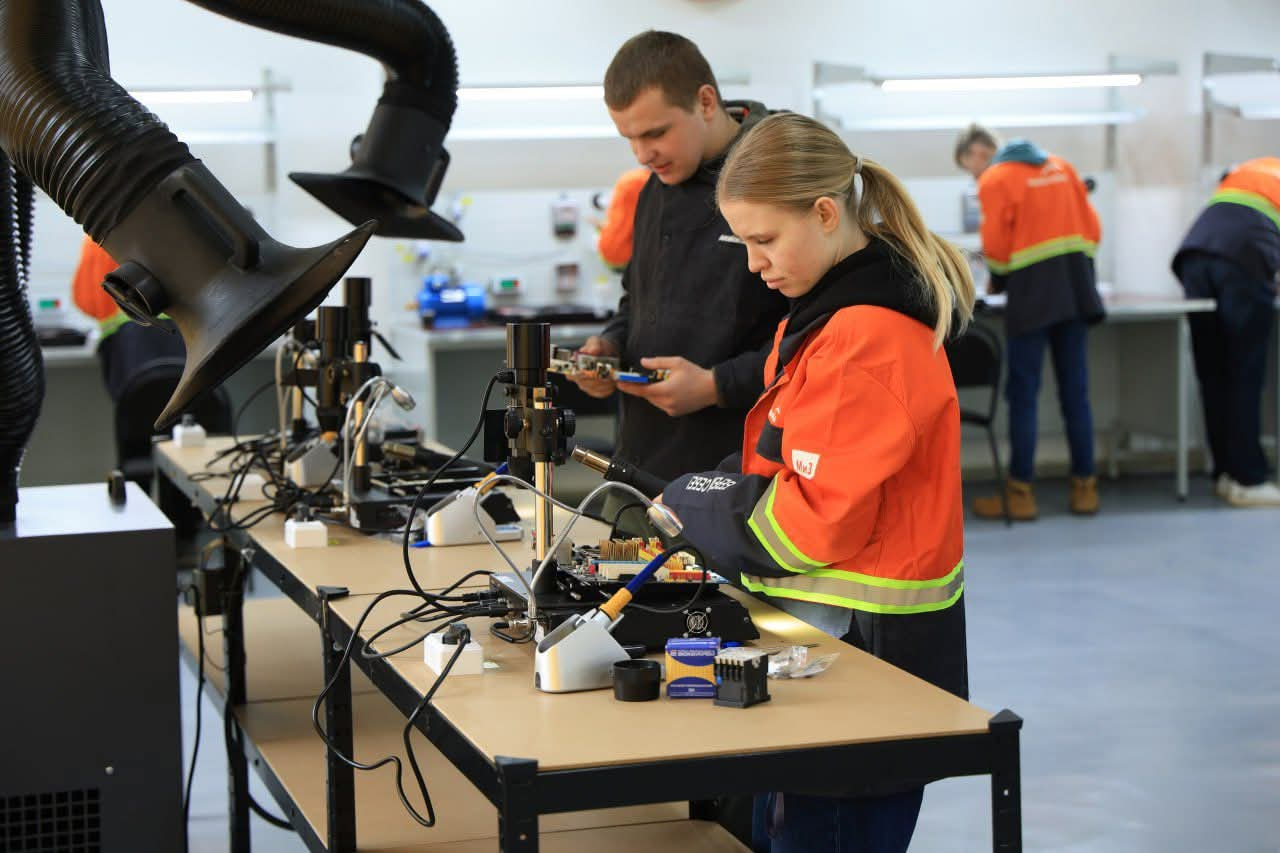
Her professional journey began in the lyceum’s electrician training workshop, which was given a new lease of life through the KRYTSIA: Support for Recovery of Kryvyi Rih Raion project, funded by the Grand Duchy of Luxembourg and implemented by LuxDev – Luxembourg Development Cooperation Agency, in partnership with Proman and NDI.
During her studies, Karina had the opportunity to learn her profession not only from textbooks. The renovated workshop was equipped with modern electrical equipment, training stands, professional tools and materials. Here, students could develop practical skills in conditions close to a real working environment: installing electrical equipment, carrying out electrical installation work, reading electrical diagrams, diagnosing and maintaining electrical systems, and following modern occupational safety standards.
“The new workshops gave me my first real professional experience,” Karina says.
For her, studying was not simply about preparing for exams. It was an opportunity to understand what the profession looked like in practice. Alongside technical skills, she developed attentiveness, a sense of responsibility and confidence in her abilities.
The next step was her participation in Novа Fabryka 3.0, a programme by ArcelorMittal Kryvyi Rih. It gave Karina an opportunity to see a large industrial enterprise from the inside, learn about its technologies, meet experienced professionals and gain a better understanding of what her future career could look like.
Soon, she had an opportunity to put her knowledge into practice in the workplace. Karina works as an electrician. She carries out responsible production tasks, continues to develop her professional skills and now has first-hand experience of moving from education to employment in her chosen field.
Creating these pathways — from modern education to real employment — is one of the key goals of KRYTSIA’s support for vocational education.
In partnership with the Volyn Resource Centre, the project is helping to modernise the vocational education system in Kryvyi Rih Raion by creating modern training workshops, updating educational programmes in line with labour market needs, strengthening the capacity of teachers and career counsellors, and encouraging young people to consider in-demand skilled professions.
So far, 21 vocational education institutions have received support through the project. Nine modern training workshops have been created or upgraded, and 15 educational programmes have been updated. This gives students the opportunity to develop practical skills using equipment that closely reflects the technologies and tools they will encounter in the workplace. They can train in welding, automotive maintenance and repair, the installation and maintenance of solar power systems, and other professions in demand on today’s labour market.
The changes go beyond equipment and infrastructure. Eighty teachers have already received training, while 270 career counsellors have gained new tools to work with young people and support them in making informed career choices. Every year, around 1,000 students will have the opportunity to study in modernised workshops and gain the practical experience they need to start their careers.
For the project, this means investing not only in educational infrastructure, but also in the people who will shape the future of the region — working in industry, energy, construction, transport and other sectors that are essential to its development.
Karina’s story is one example of how this support translates into real opportunities. It starts with choosing a profession and taking the first classes in a modern workshop, continues with gaining first-hand experience of real production, and leads to a first job.
Modern education can be the first step towards a career. And a career can become an opportunity to build a future and contribute to the recovery of Ukraine.